
In the fast-paced world of startups, efficiency and scalability are key to success. One way to achieve these goals is through end-to-end workflow automation. By automating repetitive tasks and streamlining processes, startups can focus on growth and innovation.
Let’s explore how end-to-end workflow automation can benefit startups, especially those eyeing expansion, and how Golang (Go language) can play a crucial role in this transformation.
Why End-to-End Workflow Automation is Essential
End-to-end workflow automation involves automating the entire process from start to finish. This means that every step, from initial customer contact to final delivery, is streamlined and automated. Here are some key benefits:
- Increase Efficiency
Automation reduces the time and effort required to complete tasks, allowing your team to focus on more strategic activities.
- Consistency & Accuracy
Automated processes ensure that tasks are completed consistently and accurately, reducing the risk of human error.
- Scalability
As your startup grows, automated workflows can easily scale to handle increased workloads without the need for additional resources.
- Cost Saving
By reducing the need for manual labor, automation can lead to significant cost savings over time. - Improved Customer Experience
Faster and more accurate processes lead to better customer satisfaction and loyalty.

How Golang Enhances Workflow Automation
Golang, also known as Go, is a powerful programming language that offers several advantages for workflow automation:
- Performance
Golang is known for its speed and efficiency, making it ideal for handling high-volume tasks and processes. - Concurrency
Golang’s built-in support for concurrency allows multiple tasks to be executed simultaneously, improving overall efficiency. - Simplicity
Golang’s simple syntax and ease of use make it accessible for developers, reducing the time required to develop and maintain automated workflows. - Scalability
Golang’s scalability ensures that your automated workflows can grow with your startup, handling increased workloads without compromising performance.
Key Areas for Workflow Automation
- Customer Relationship Management (CRM)
- Automate customer data entry and updates to ensure accurate and up-to-date information.
- Use automated email campaigns to nurture leads and keep customers engaged.
- Implement chatbots to handle common customer inquiries and provide instant support.
- Sales and Marketing
- Automate lead generation and scoring to identify high-potential prospects.
- Use automated workflows to manage marketing campaigns and track performance.
- Implement automated reporting to gain insights into sales and marketing activities.
- Finance and Accounting
- Automate invoicing and payment processing to reduce manual effort and improve accuracy.
- Use automated workflows to manage expense reporting and approvals.
- Implement automated financial reporting to gain real-time insights into your startup’s financial health.
- Human Resources (HR)
- Automate employee onboarding and offboarding processes to ensure a smooth transition.
- Use automated workflows to manage employee records and compliance requirements.
- Implement automated performance reviews and feedback processes to support employee development.
- Project Management
- Automate task assignments and tracking to ensure projects stay on schedule.
- Use automated workflows to manage project documentation and approvals.
- Implement automated reporting to gain insights into project progress and performance.
Implementing Golang for Workflow Automation
- Identify Key Processes
- Start by identifying the key processes that can benefit from automation.
- Focus on repetitive tasks that consume a significant amount of time and resources.
- Develop Automation Workflows
- Use Golang to develop automation workflows that streamline these processes.
- Ensure that workflows are designed to handle high volumes and can scale with your startup’s growth.
- Integrate with Existing Systems
- Integrate your automated workflows with existing systems and tools to ensure seamless operation.
- Use APIs and other integration methods to connect different systems and enable data sharing.
- Monitor and Optimize
- Continuously monitor the performance of your automated workflows to identify areas for improvement.
- Use analytics and reporting tools to gain insights into workflow performance and make data-driven decisions.
- Train Your Team
- Provide training and support to your team to ensure they can effectively use and manage the automated workflows.
- Encourage feedback and suggestions for further improvements.
By leveraging end-to-end workflow automation and the power of Golang, startups can achieve greater efficiency, scalability, and cost savings. This allows them to focus on growth and innovation, ultimately driving success in a competitive market. Embrace automation and watch your startup thrive as you eye expansion and new opportunities.
More Articles

Taming the Digital Labyrinth: A Guide to Business Process Automation for SMEs
Let's face it: running a Small to Medium-sized Enterprise (SME) in the Philippines is a constant balancing act. You're wearing multiple hats, juggling tasks, and trying to spark new ideas while simultaneously ensuring the day-to-day operations don't spiral into a...

Beyond the Code: How Collaborative Workshops Turn Wild Ideas into Scalable Apps
Ever had a brilliant app idea buzzing in your head, so clear and revolutionary, yet felt overwhelmed by the thought of bringing it to life? You know it has the potential to be a game-changer, but the journey from "aha!" moment to a fully functional, scalable app can...

Why Your Growing Startup Should “Go” Fast: The Perks of Golang for Business
Hey there, fellow innovators! Ever feel like your business is a race car, but your current tech stack is stuck in first gear? You’ve got brilliant ideas, a growing user base, and a vision that's going to change the game. But sometimes, legacy systems or slow-poke...
Case Study
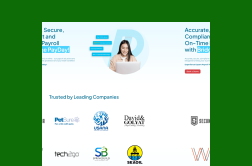
Case Study: Bridging the Gap Between Complex Payroll and Seamless UX
In the fast-paced and highly regulated business environment of the Philippines, payroll is far more than just a monthly administrative task—it is a cornerstone of operational trust and employee satisfaction. Bridge Payday has established itself as a premier partner in...

Case Study: AutoNex Golang eCommerce Website
AutoNex is a dynamic eCommerce platform that specializes in providing top-quality car parts for all types of vehicles. Whether you drive a compact car, a rugged SUV, a powerful truck, or a sleek sports car, AutoNex has an extensive selection of parts to suit your...
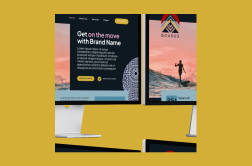
Case Study: Diwa Lifestyle Branding
Diwa Lifestyle is an emerging company dedicated to crafting high-quality sports boards, such as surfboards, and plans to expand into apparel and travel essentials. With a mission to promote local surfboard shapers and skilled craftsmen, Diwa sought to create a unique...